
The market hasn’t been performing too hot lately. Should you care? As I read posts of personal finance bloggers liquidating accounts and encouraging readers to get out and wait until they feel confident in the market again, I see people falling into the single biggest trap in investing: trying to time the market.
For the most part, the personal finance community agrees that the most important decision you make with your portfolio is strategically choosing your asset allocation and sticking with it. The not so easy part is sticking with it, even through a market downturn.
I recently wrote about the true cost of active investing and would like to further illustrate the point as I see people contemplating their options in a struggling market.
The main factor working against market timing is that stock gains often come in quick, intense bursts. Miss enough of them and you lose all of the long-term advantages of owning stocks.
Remember 2004? It was a good year for stocks, with the S&P 500 index returning 10.9%. However, the rise was hardly smooth. From January through October 25 of that year, the S&P 500 was actually slightly down. Three-quarters of 2004’s return came in the following 14 trading days! If you were waiting till you felt confident in the market, you would have missed out completely. The more you try to time the market, the greater your chances of missing the market’s biggest single-day gains.
The opportunity cost can be substantial if you miss the best days by staying on the sidelines. Over the last 10 years ending June 30, 2006, missing the best 10 days of the S&P 500 (that’s 10 out of 2,517 total trading days) would have reduced your annual return from 8.3% to 3.3%.
On June 30, 1994, Bill invested $10,000 in a stock index fund based on the S&P 500 Stock Index. As noted in the chart below, by June 30, 2004, the $10,000 would have grown to $31,260, an average annual total return of 12.07%.
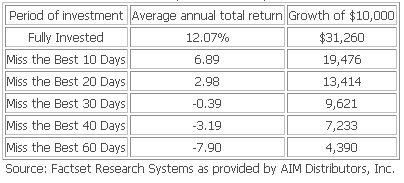 However, suppose Bill decided to get out of the market during volatile periods in those ten-years, and as a result he missed the market’s ten best single-day performances. If that were the case, his 12.07% return would have fallen to 6.89%. If Bill missed the market’s best 20 days, his return would have dropped to 2.98%. Adding in transaction costs would have reduced his return even further.
You can’t control the markets, but you can control how you react to them. Don’t let short-term volatility drive your long-term investment planning. Long-term investors can ignore short-term market action. Your best defense against a fluctuating market is a well-diversified portfolio and a disciplined program of periodic investments. As Peter Lynch said, The real key to making money in stocks is not to get scared out of them.
I couldn’t agree more … decide on your asset allocation and stick to it!
Agreed, if the best financial managers in the world can’t time the markets, it’s naive to think you can as an individual investor. However, it is good to be hedged. What I was able to do during this recent market downturn was cash in my puts on the QQQQs and a put on AAPL (I had gone long and short with a “strangle” option play just prior to earnings. If you hedge yourself into a market neutral return, you may be defeating the upward trend of the market long term, but in having a small part of your portfolio in investments that zig when the market zags, you can then liquidate them, swoop back in and pick up bargains. The proceeds from these moves have gone into the likes of VIP, WBD and other stocks that have already returned over 10% since they were overly punished during the recent downturn.
Thank you!
Excellent post, I couldn’t agree more.
Thanks nolandda, I’ve fixed the link.
Clint,
I would be interested in what dates these are that support the statement made that — “Over the last 10 years ending June 30, 2006, missing the best 10 days of the S&P 500 (that’s 10 out of 2,517 total trading days) would have reduced your annual return from 8.3% to 3.3%”
Do you have those data points available and can provide?
Regards,
L.A. Little
L.A. Little,
I’m sorry but this article was written over 2 years ago, And I can’t remember the exact report source.